
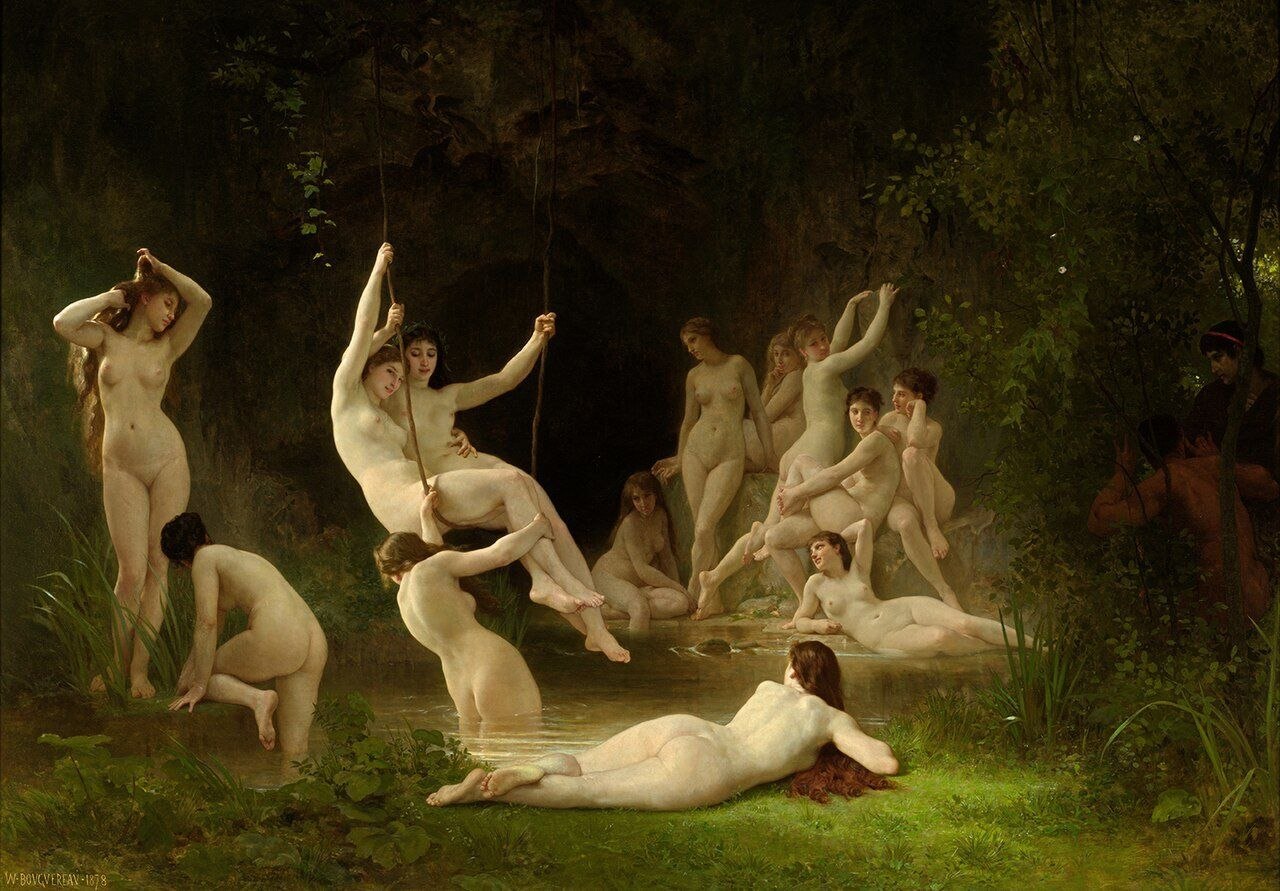
William-Adolphe Bouguereau (French, 1825–1905) — The Nymphaeum (El Ninfeo), 1878. Oil on canvas, 57 × 82.5 in. Haggin Museum, Stockton, California.
Bouguereau again — the man who painted beautiful women like other people breathe. This time: an entire colony of them, gathered around a fountain like it’s the last cool water in the Mediterranean, doing absolutely nothing except being exquisite.
A nymphaeum, historically, was a shrine dedicated to nymphs — usually built around a spring or fountain, because the Greeks correctly understood that water and beautiful supernatural women go together. Bouguereau turns the religious architecture into a spa day: a group of nude nymphs by a stone fountain, some standing, some sitting, some draped, all rendered with his trademark impossibly smooth skin.
This is Bouguereau at maximum output: multiple figures, complex composition, marble, water, foliage, and flesh — all the stuff he was unbeatable at. The man painted over 800 works and the nymphaeum was one of his most successful Salon pieces of the 1870s. When critics complained his women were too idealized, too perfect, too unreal, his answer was essentially: have you seen my sales figures?
Note the one clothed figure in the mix — the water carrier with the jar — because Bouguereau understood contrast: give them 90% nudity, throw in one draped woman, and suddenly the nudity reads as classical rather than scandalous. A master of plausible deniability.
And the nymphaeum itself — the stone shrine — is doing work too. This isn’t just a bath scene; it’s a temple scene. These women are at a sacred spring, performing the ancient ritual of being completely gorgeous near water. It was practically a job description in Greek religion.
The Haggin Museum in Stockton has owned it since 1908 and it’s been their crown jewel ever since. Somewhere in central California, a shrine to nymphs survives, and Bouguereau’s flawless women are still having their eternal spa day.

0 Comments