
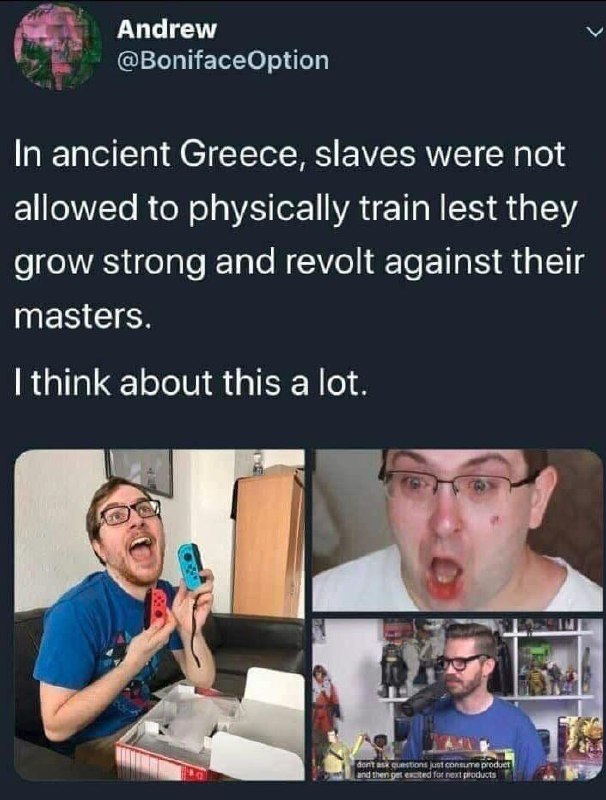
@BonifaceOption: “In ancient Greece, slaves were not allowed to physically train lest they grow strong and revolt against their masters. I think about this a lot.”
The meme below: the Switch-unboxing scream, the reaction face, and the caption — “don’t ask questions just consume product and then get excited for next products.”
The historical claim is a simplification but rooted in something real. Greek city-states had a genuine fear of slave revolts, and training was controlled in various ways:
- In Sparta, the helots — the state-owned serfs who outnumbered the Spartiates by as much as 10-to-1 — were kept systematically broken: forced to drink undiluted wine to humiliate them, forbidden from military training, and subjected to the krypteia, the secret police force that young Spartiates joined to murder helots at night, precisely to keep them terrorized and weak. Sparta was so afraid of the helots that it built its entire warrior society around the need to keep them down.
- In Athens, physical training at the gymnasium was a citizen’s activity — the gymnasium (literally ‘the naked place’) was where the male citizen body was built and displayed. Slaves could attend in some roles, but as servants and attendants, not as athletes. The gymnasium was a marker of free status as much as a training ground.
- Aristotle, in the Politics, wrote about how the constitution of Crete ‘takes precautions’ against slave revolts — and noted that cities which let slaves get too strong faced the consequences. The fear was systemic and ancient.
- The broader point: strength training in the ancient world was political. A fit body was a free body. The muscle was a symbol of citizenship — and the exclusion of slaves from the gym was the same logic as denying them weapons: you don’t arm or strengthen the people you’re oppressing.
The modern punchline: we don’t ban the gym. We give everyone a credit card and a streaming service, and make sure the rage is pointed at the other side of the culture war instead of at the ceiling. Ancient masters feared strong bodies; modern systems fear idle minds — so they keep the bodies busy consuming and the minds busy arguing.
Appreciation:
– The genius of the tweet is that it’s probably 60% real and 40% vibes, and it doesn’t matter: the historical kernel (Sparta’s helot terror) is real, and the modern contrast lands.
– The Switch-unboxing scream is the perfect visual: a grown man weeping with joy over a plastic console — the ancient world would have assumed he was being poisoned.
– ‘Don’t ask questions just consume product and then get excited for next products’ is the modern equivalent of the Spartan krypteia: we’re not murdered in the night; we’re just never given a reason to look up from the feed.
– The Roman version: Juvenal called it ‘bread and circuses’ (panem et circenses) in 100 AD — feed them and entertain them, and they will not notice they are unfree. The meme is that idea with a Nintendo logo.
– And the darkest layer: the tweet says ‘I think about this a lot.’ That’s the point. The person who thinks about it is already revolting — just in a way the gymnasium ban could never have predicted: quietly, online, one meme at a time.
In ancient Greece they banned the barbell. In modern America they hand out the barbell-shaped products. The revolt has been rescheduled indefinitely — but the tweet is a start.

0 Comments