
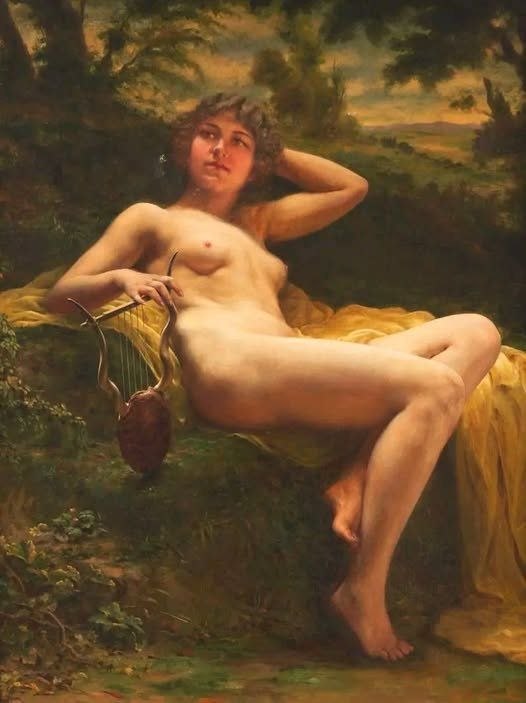
Attributed to Frédéric Soulacroix (French, 1858–1933) — Nymph in a Glen (Nymphe dans un vallon), undated, c. 1890s. Oil on canvas, 64.1 × 48.3 cm. Private collection. Sold at Freeman’s, April 2025 (est. $12,000).
Attribution caveat: this one comes with a sign saying ‘handle with doubt’ — the painting is not securely documented as an authenticated Soulacroix. The signature may be later, the market may be optimistic, and the art historians are doing that slow head-shake. We post it anyway because the glen is gorgeous and the nymph is glowing.
Now, the man himself: Soulacroix was born in Rome to the French painter Charles Soulacroix and the Italian painter Giacinta Dio — literally raised inside the art world — and spent his career painting exactly this: elegant 18th-century-styled women in gardens, boudoirs, and mythological settings. His work sold so consistently in his lifetime that he became one of the most commercially successful painters of the Belle Époque. The French called them ‘les jolies femmes’ paintings. Everyone called them money.
This nymph, though — look at the lighting. She’s lying in a glen that glows like it’s lit from inside the moss. Her skin picks up the green of the leaves and the gold of the sun in the same brushstroke, and the whole scene feels like the forest just opened one of its best rooms for her. Whether Soulacroix painted it or not, someone who knew exactly what they were doing painted it.
And that’s the beauty of an uncertain attribution: the painting doesn’t care. It hangs in a private collection either way, a gorgeous nymph in a glen, and the question of who signed it just adds spice to the auction catalogue. Art history is 50% paintings and 50% ‘actually, we’re not sure about that one.’
If it IS Soulacroix: the man painted for a living, reliably, elegantly, and his nymphs were some of the best in the business. If it ISN’T: some unknown painter produced something good enough to ride the Soulacroix name for a century. Either way, a win.

0 Comments