
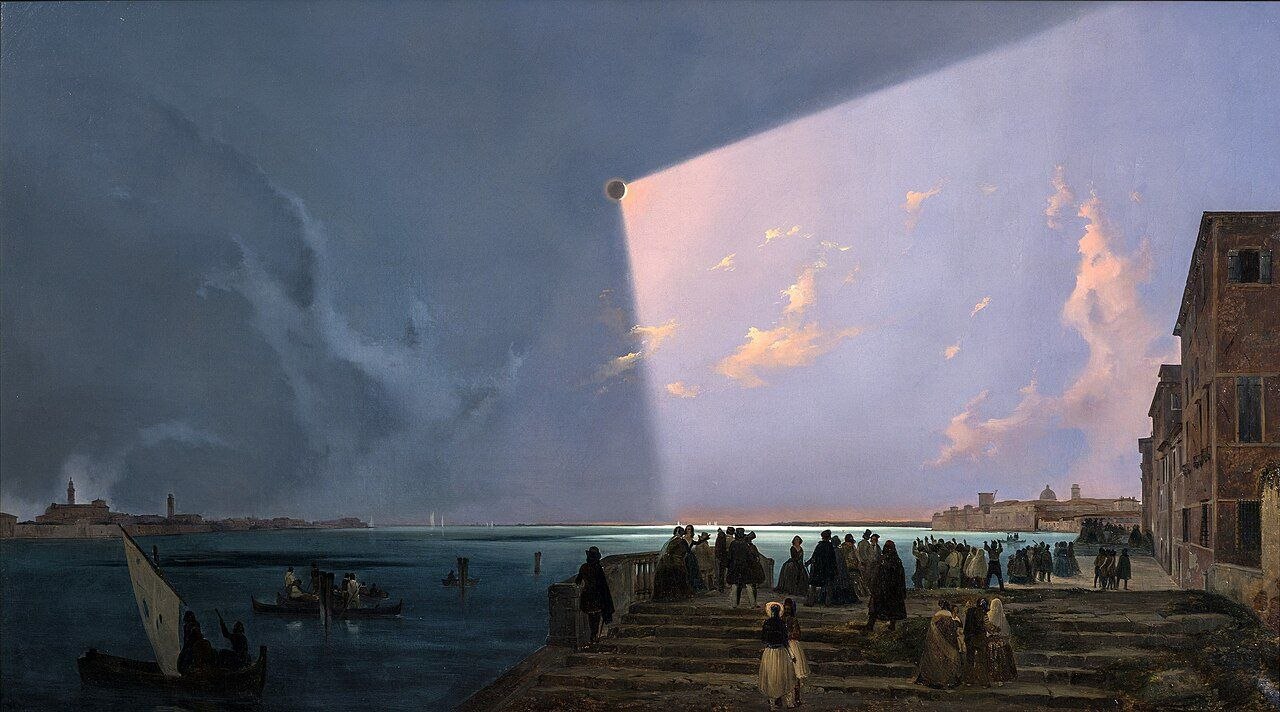
The Eclipse of the Sun in Venice, July 6, 1842 — Ippolito Caffi (1842)
Venetian painter Ippolito Caffi (1809-1866) painted what he saw on the morning of July 6, 1842: a total solar eclipse seen from the Riva degli Schiavoni, with St. Mark’s Campanile and the domes of the basilica silhouetted against the darkened sky. The crowd on the embankment has stopped — gondoliers, townsfolk, children — all looking up at the corona blazing through the clouds.
This is one of the great pre-photography eclipse documents. Caffi didn’t invent the scene; he witnessed it, then gave the science to posterity with a painter’s drama. The deep blue of the left sky, the pink-tinged clouds on the right, the vertical shaft of light descending like a divine spotlight — this is what 1842 Venice actually saw, plus one very talented man’s awe.
Appreciation, because we love an eclipse painter:
– The ancient world treated eclipses as omens of doom; the Victorians treated them as must-see tourist events. By 1842, the ‘eclipse panic’ had already given way to eclipse tourism — people traveled from across Europe to stand in the shadow path and yell ‘magnificent.’
– Caffi was the ultimate destination painter — he painted bombed-out Rome, Naples, the Alps, the Middle East, and he died when a Venetian ship he was on was sunk in the Adriatic during the Third War of Independence. The man who painted eclipses died during a naval bombardment; the sky finally got him.
– The funny bit: everyone in the foreground is staring at the sky, and the dog (if present in this version) does not care. Dogs never care about eclipses. They care about dinner.
– And the eternal eclipse joke: the Romans thought an eclipse was the sun being swallowed by a dragon, so they banged pots and pans until it came back. The Venetians of 1842, by contrast, had telescopes, precision, and Caffi on the embankment. Progress.
#titsoutart

0 Comments