
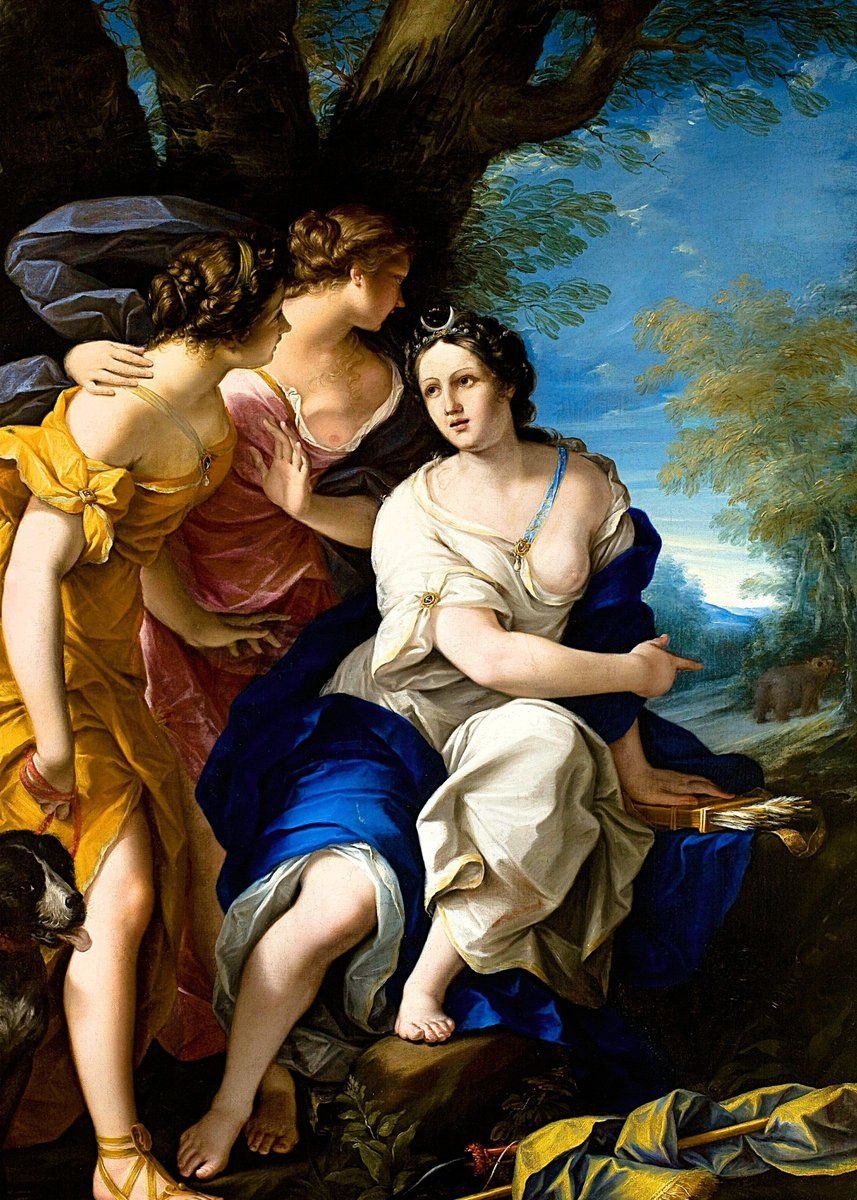
Felice Torelli (Italian, 1667–1748) — Diana with Nymphs. Oil on canvas, National Museum in Warsaw.
Diana, goddess of the hunt, surrounded by her entourage and looking like she just found out one of them is a man. Which, to be fair, is the exact plot of half the myths about her.
Bolognese painter Felice Torelli — brother of the more famous Giuseppe Maria Torelli, and a member of the Accademia Clementina — spent his career painting exactly this kind of scene: mythological group shots with gods, nymphs, and dramatic Baroque lighting. He learned the trade under Giovanni Gioseffo dal Sole and then under the great Lorenzo Pasinelli, and by the 1720s he was one of the busiest painters in Bologna. Fun family fact: his brother was a violinist and composer, so the Torelli household was basically one half easel, one half concert hall.
This Diana is not the serene marble huntress of later art. This is Baroque Diana — caught mid-scene, arm raised, pointing at something off-frame, with her hand on the bow and the whole group arranged like a stage tableau. The nymph in yellow with the dog, the one in pink leaning in like she’s got gossip, the crescent moon diadem on Diana’s head. And there’s a bear in the far distance, which is either foreshadowing or a very poorly timed family outing.
The blue sash, the white tunic, the dramatic sky — Torelli stacked all the Baroque tricks. It’s not subtle. It’s not supposed to be. This is 18th century Italian painting at maximum volume: everybody gesturing, everybody draped, one small dog doing his best to be in the painting.
Diana’s whole thing was virginity and the hunt, and the nymphs were her sworn chaste crew — until Actaeon stumbled in, saw them bathing, and got turned into a stag and eaten by his own hounds. Moral of the story: mind your business, or you become the main course. The dog in the corner knows what happened.

0 Comments