
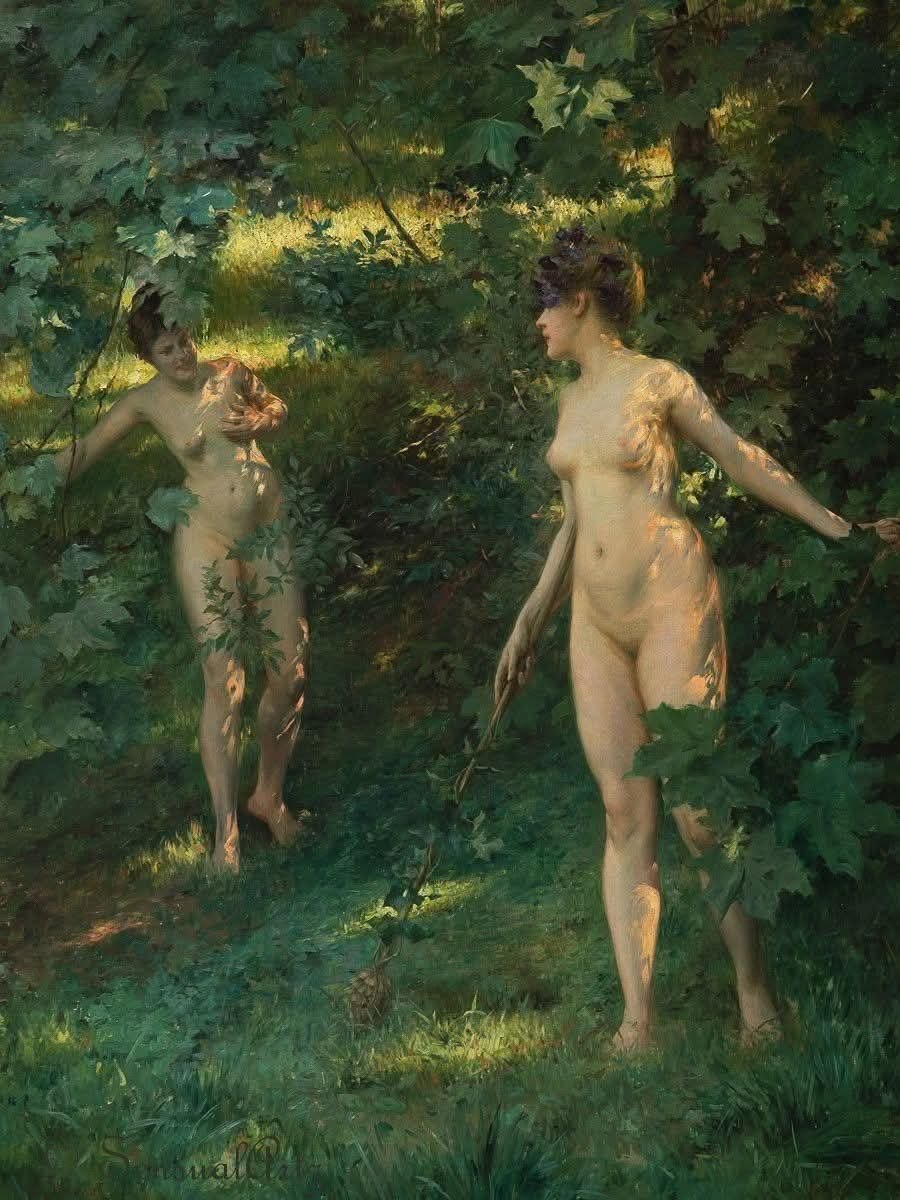
Julius LeBlanc Stewart (American, 1855–1919) — Nymphs of Nysa (Les Nymphes de Nysa), 1900. Oil on canvas, 143 × 115 cm. Musée d’Orsay, Paris.
An American who out-Paris’d the Parisians. Julius LeBlanc Stewart was born in Philadelphia, moved to Paris at 10, studied under Jean-Léon Gérôme, and became one of the most successful expat painters of the Belle Époque — so French that the French called him ‘le parisien de Philadelphie.’
Nymphs of Nysa shows the nurses of Dionysus: the nymphs who raised the wine god in the hidden valley of Nysa. Stewart gives us two of them in a sun-dappled forest, one holding a staff, both rendered with the kind of soft, luminous skin that made him famous. The light does the heavy lifting — patches of sun through the leaves, cool shadows, the glade glowing like the morning after a good party.
The Nysa nymphs are the mythical original wine moms: they got entrusted with the future god of wine, and history records they did an excellent job, because the god they raised turned out to be the life of every party ever. Dionysus would later repay them by making them stars of the sky. That’s what happens when you’re the designated caretaker of a deity who becomes synonymous with celebrations.
Stewart painted society portraits and nude mythologies with the same ease, and this one sits in the Musée d’Orsay — a shrine to exactly the kind of dreamy, elegant fin-de-siècle painting Paris was world-famous for. The nymph with the staff looks like she’s about to lead the other one somewhere important, possibly to a vine. Two gorgeous mythological babysitters, frozen in the best light of their eternal morning, in one of the greatest museums on Earth.
Fun fact: Stewart’s social circle included the Vanderbilts and the Whitneys, and he threw the legendary ‘Stewart’s Ball’ of 1897, considered the most lavish party of the Belle Époque. The man painted wine-god nursemaids and then lived like Dionysus himself. Everything checks out.

0 Comments