
Every generation thinks this time is different. That this new invention is where humanity finally went too far. And every generation is wrong.
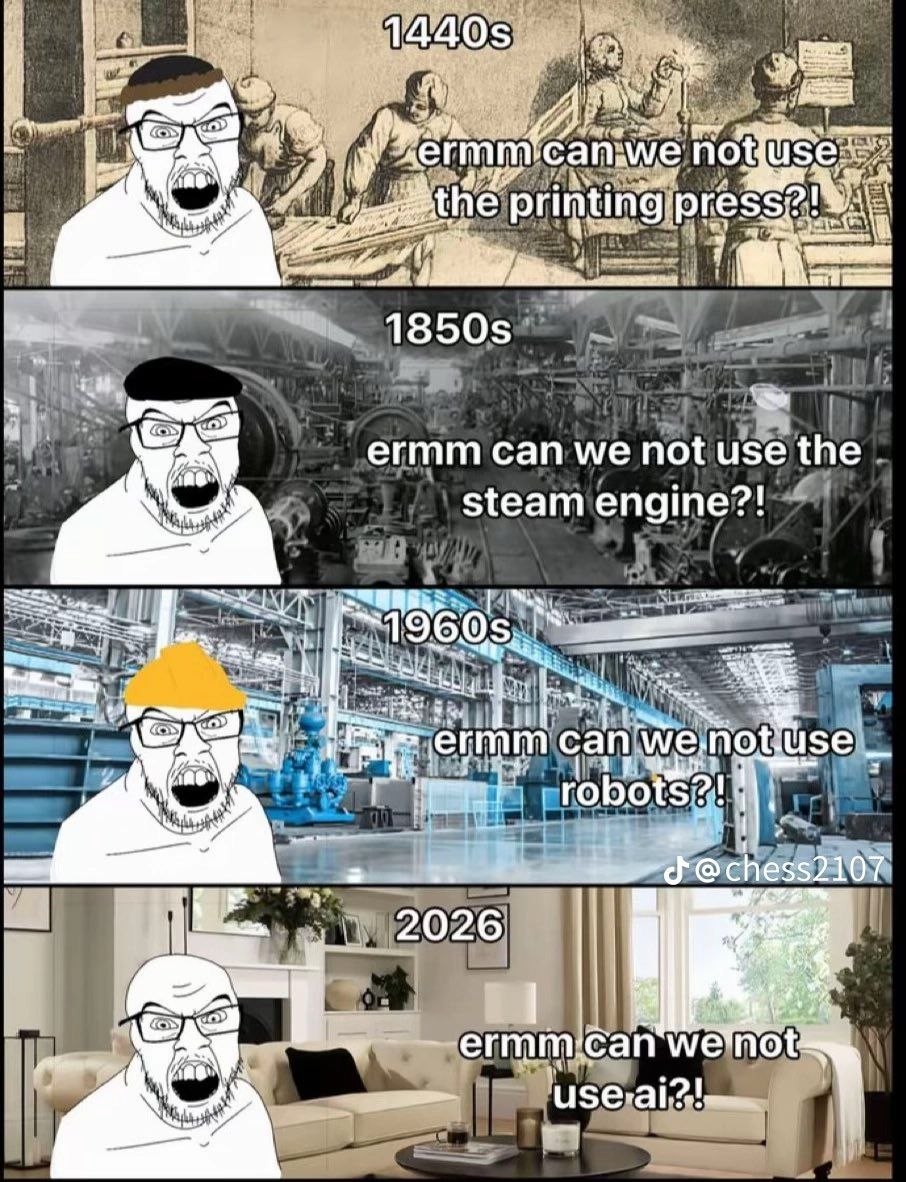
Meet our recurring hero: a bearded, bespectacled man who has been yelling “ermm can we not use X?!” for the past 600 years. He shows up at every pivotal moment in human history to announce that whatever shiny new thing just arrived is definitely going to ruin everything. He is wrong every single time.
The Four Panels
1440s — The Printing Press
Johannes Gutenberg invents movable type, and within a decade books are rolling off presses across Europe. Our hero, wearing period-appropriate garb, scowls at the contraption: “ermm can we not use the printing press?!”
What he feared: Too many books would confuse people, undermine scribes, spread dangerous ideas.
What actually happened: The Renaissance, the Reformation, the Scientific Revolution, literacy for the masses, and basically everything we call modern civilization.
1850s — The Steam Engine
The Industrial Revolution is in full swing. Steam-powered factories, locomotives, and ships are transforming the world. Our hero, now in a Victorian suit and top hat, stands before a factory floor: “ermm can we not use the steam engine?!”
What he feared: Machines would destroy craftsmanship, displace workers, pollute the air, dehumanize society.
What actually happened: It did displace workers (that part was real), but it also lifted billions out of subsistence farming, enabled global transport, and created the modern economy. The Luddites (actual historical figures who smashed textile machines) became the namesake for technophobia itself.
1960s — Robots
The first industrial robots appear on assembly lines. Our hero, now sporting a yellow hard hat, stands defiantly before a robotic arm: “ermm can we not use robots?!”
What he feared: Robots would take all the jobs, reduce humans to button-pushers, create a cold mechanical world.
What actually happened: Robots took the dangerous, dirty, and dull jobs — the ones humans shouldn’t be doing anyway. Manufacturing boomed. Workplace safety improved. New categories of work emerged that nobody had imagined.
2026 — AI
White couch. Coffee table. Potted plant. Our hero (now fully gray-bearded, possibly even an AI-generated version of himself) looks into the lens: “ermm can we not use ai?!”
What he fears: AI will replace artists, writers, programmers, thinkers. It will destroy creativity, spread misinformation, and maybe (depending on who you ask) end humanity.
What the historical pattern suggests: Same script. Different century. The mask has changed but the Luddite is eternal.
The Gorgocutie Mythological Lens
This meme isn’t just funny — it’s deeply archetypal. Look through mythology and you see the same pattern of fear of the new playing out since the dawn of consciousness.
Prometheus and Fire: When Prometheus stole fire from Olympus and gave it to mortals, he was essentially handing humanity its first “disruptive technology.” Fire could cook food, forge tools, light the darkness — but it also burned. Zeus, the ultimate Luddite, punished Prometheus savagely. The fire was “too dangerous” for humans to have. And yet, without fire, no civilization. No metallurgy. No cooked meals. No campfire stories. No us.
Hephaestus and Automation: The god of the forge built automated servants — golden handmaidens that could move and speak, self-propelled tripods that waited on the gods. He was the original roboticist. The Greeks both admired and feared his creations. Sound familiar?
Pandora’s Box (Jar): The very first woman, the myth goes, was given a jar containing all the evils of the world — and told not to open it. She did, of course. The “don’t open that box” is the mythic equivalent of “ermm can we not use that?” Every new technology is Pandora’s jar. Opening it releases chaos — but also hope, which was the last thing left inside.
Daedalus and Icarus: The inventor who built wings to escape the labyrinth. Icarus flew too close to the sun and fell. The moral? Not “don’t fly” — but “learn to fly wisely.” The wings themselves weren’t the problem.
The Punchline
Humans have been saying “ermm can we not” since Prometheus handed us the first spark. Every god-given gift was first met with suspicion, resistance, and outright panic. The printing press was going to destroy society. The steam engine was going to destroy society. Robots were going to destroy society.
And now AI is going to destroy society.
Maybe it will. Or maybe — just maybe — the guy who’s been wrong since 1440 is wrong again.
Post scriptum: This post was written with AI assistance. We’re aware of the irony. We leaned into it.

0 Comments