
Every so often, the internet stumbles upon a truth so perfect, so obvious in retrospect, that you wonder why nobody said it before. This is one of those moments.
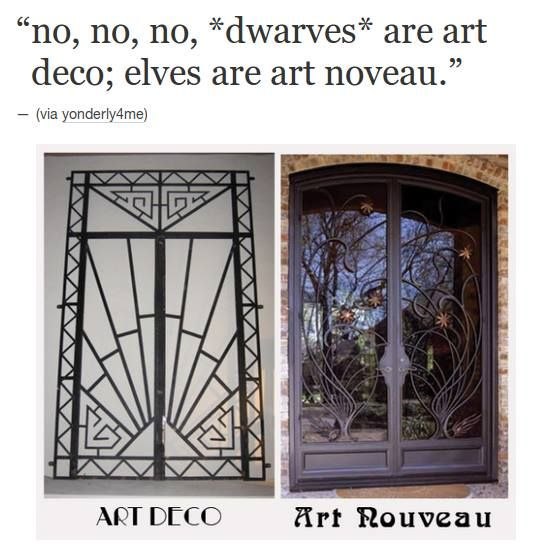
The Tumblr screenshot, via yonderly4me, reads: “no, no, no, dwarves are art deco; elves are art nouveau.” And if you look at the accompanying images, the thesis is undeniable.
The Visual Evidence
On the left: an ornate black metal gate with sharp, geometric Art Deco patterns—chevrons, sunbursts, straight lines, symmetry. It’s the kind of gate you’d expect to find guarding the entrance to Erebor, Khazad-dum, or any dwarven hold carved into the living rock of a mountain. The linework is precise, mathematical, almost industrial.
On the right: a wooden door inset with curving, organic Art Nouveau glass panels—flowing vines, leaves, naturalistic shapes. This is the door of Rivendell, Lothlorien, or the elven halls of Menegroth. It looks as if it grew there, shaped by patient hands that understood that beauty is not imposed on nature but coaxed from it.
The bottom labels confirm the comparison: “ART DECO” on the left, “Art Nouveau” on the right.
Why It Works: Hephaestus vs. Apollo
In Greek mythology, Hephaestus was the god of the forge, the smith, the artisan who worked with fire and metal. His creations were precise, functional, geometric—the automata of bronze, the shields of heroes, the traps of the gods. Dwarves in Norse and Tolkienian mythology are Hephaestus’s children: master smiths who shape the bones of the earth into crowns and weapons and gates. Their architecture is carved, structured, symmetrical. It is the geometry of the forge.
On the other side, Apollo was the god of music, poetry, light, and proportion—but also of flowing, harmonious beauty. His domain was not the angular perfection of the smithy but the curved grace of the lyre, the laurel, the sun’s arc. Elves in the Northern tradition are Apollo’s cousins: beings of light and song, whose architecture grows from the landscape like a melody unfolds. Art Nouveau’s flowing lines, natural motifs, and organic curves are exactly what an elven smith would craft if they put down their harp and picked up a chisel.
The Deeper Mythological Parallel
This is more than a clever aesthetic observation. It’s a fundamental insight into how fantasy races mirror real-world cultural and artistic movements.
- Dwarves = Art Deco: Symmetry, angularity, precious materials (gold, marble, gemstones), geometric patterns, the glorification of structure and order. Art Deco emerged from a world that believed in progress through industry and precision. Dwarves would feel right at home in a 1920s New York skyscraper.
- Elves = Art Nouveau: Asymmetry, flowing lines, natural motifs (vines, leaves, flowers, animals), the integration of form and function. Art Nouveau was a reaction against industrial rigidity, a yearning for the organic and the handcrafted. That’s elven philosophy distilled.
You could even extend the metaphor: Humans = Bauhaus (functional, minimalist, “form follows function”), Orcs = Brutalism (raw concrete, massive scale, intimidating presence), Halflings = Arts and Crafts (cozy, handcrafted, natural materials). But that’s a post for another day.
The Takeaway
The next time someone tells you fantasy is “just” escapism, show them this meme. Fantasy isn’t escape—it’s a mirror. The architectural styles we created in the 20th century are the same ones we’ve been imagining for mythical races for over a century. The dwarves and elves were never just in the books; they were in the buildings, the gates, the doors we walk through every day.
And if you ever find yourself in front of an Art Deco building and think “this feels dwarven,” or see an Art Nouveau gate and whisper “that’s elven,” congratulations: you’ve been initiated into the secret mythology of architecture.
Via: yonderly4me on Tumblr. Art Deco vs. Art Nouveau. Dwarves vs. Elves. The internet delivered.

0 Comments