
Let me tell you a story about fate, fortune, and the quiet, relentless chuckle of the gods.
There’s a screenshot from a Quartz article that’s been doing the rounds, and it hits like a gut punch wrapped in a gilded frame. The headline reads: “The richest families in Florence in 1427 are still the richest families in Florence.” Six hundred years. Think about that.
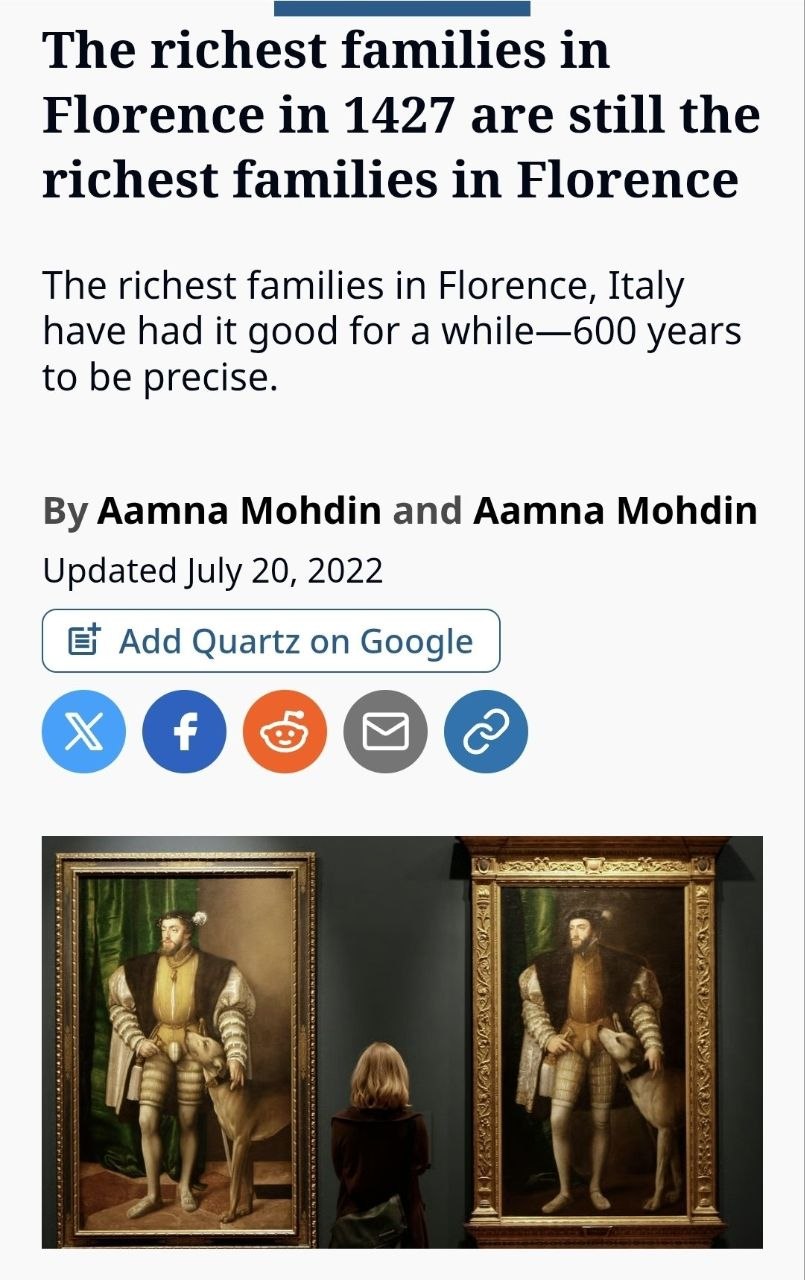
The sub-headline doubles down: “The richest families in Florence, Italy have had it good for a while—600 years to be precise.” The article, by Aamna Mohdin, dated July 20, 2022, is accompanied by a photo of a woman standing in a museum, viewing two identical Renaissance portraits of a wealthy Florentine man in ornate gilded frames, holding a small dog. The message is unmistakable: the patrons have changed their clothes, but the dynasties remain.
Let’s talk about what this really means in mythological terms.
The Wheel of Fortune Never Turns for Some
In Greek mythology, Dike personified moral justice, while Tyche governed the whims of fortune. The old poets told us that fortune was a wheel—some rise, some fall, and the cycle keeps spinning. But what happens when a family grabs hold of that wheel and nails it to the floor? When the Medici, the Strozzi, and their peers don’t just hold onto wealth but become the very architecture of a city?
Florence in 1427 was a republic in name but an oligarchy in practice. The catasto (the Florentine tax census) of that year recorded who owned what, and modern economists have tracked those surnames across the centuries. The result? The same names that dominated the tax rolls in the Renaissance dominate the city’s wealth registers today. Same families. Same palazzos. Same bank accounts with six extra zeros.
It’s enough to make you believe in Moira — fate, the unbreakable allotment that even the gods cannot rewrite. Or perhaps it’s just good old-fashioned Eris — the discord of structural inequality dressed in Renaissance finery.
The Curse of Midas or the Blessing of Ploutos?
In the myth, King Midas begged for everything he touched to turn to gold. He got his wish, and it nearly killed him. The Florentine families seem to have the reverse curse: they touched gold, and it never turned back into anything else. Ploutos, the god of wealth, was often depicted as blind—distributing riches without regard for justice. That blindness seems to have settled on Florence for six centuries and refused to leave.
What makes this particularly Greek-tragedy is the reductio ad absurdum of the photo itself. Two identical portraits of the same rich man, hung side by side, viewed by a museum-goer in 2022. It’s as if the Fates are saying: “Look. Look at how little has changed. Look at the same face, the same dog, the same gold leaf, six hundred years apart. Did you think history had a point?”
The Verdict
This isn’t just an economics lesson. It’s a mythic pattern playing out in real time. The families of Florence are living proof that some mortals are touched by the gods in ways that defy the natural order of things. Or perhaps it’s simpler: wealth, once accumulated, builds walls that even time cannot erode.
Either way, if you’re looking for evidence that the ancient gods still walk among us, you could do worse than checking the property records in Tuscany.
Source: Quartz, “The richest families in Florence in 1427 are still the richest families in Florence,” by Aamna Mohdin, July 20, 2022.

0 Comments