
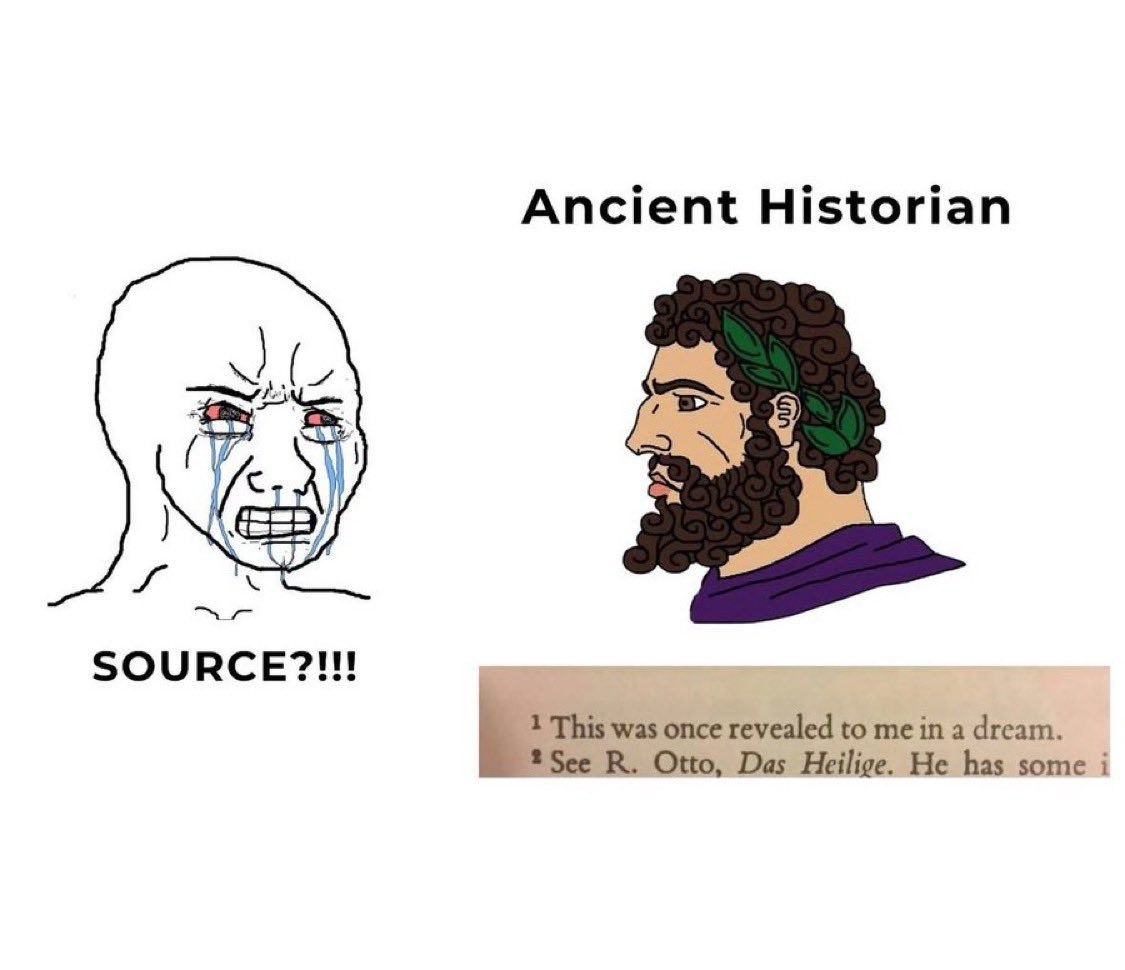
Modern reader: SOURCE?!!!
Ancient Historian: “¹ This was once revealed to me in a dream.” “² See R. Otto, Das Heilige. He has some i…”
The eternal war between modern scholarship and ancient methodology, rendered in one perfect meme.
On the left: the modern researcher, veins popping, tears streaming, screaming for a citation. The demand is absolute: where is the footnote, where is the archive, where is the peer review? Give me a verifiable source or I will die.
On the right: the ancient historian, laurel wreath on his head, purple robe draped, footnoting with the confidence of a man who has never once been asked to show his work. His primary source: a dream. His secondary source: a book by a colleague that he can’t even finish citing. And he is completely unbothered.
This is actually the single funniest thing about reading ancient history: the standards were just… different. Herodotus, the ‘Father of History,’ confidently reported that gold-digging ants in India were the size of foxes, and that flying snakes guarded frankincense trees — and he footnoted it with ‘I heard this from a priest in Memphis.’ Plutarch cited ‘some say’ as a source. Livy openly admitted he couldn’t verify early Roman history and just… wrote it anyway, because the story was good. The dream citation is barely an exaggeration; ancient authors genuinely treated divine revelation, omens, and dreams as legitimate historical evidence.
The R. Otto reference is the kicker — Rudolf Otto, the German theologian who wrote Das Heilige (The Idea of the Holy) in 1917. The ancient historian is citing a modern German theologian in the same breath as a dream, mixing timelines, traditions, and standards of evidence with total confidence. That’s the joke: even when they cite real scholarship, it’s in service of a claim sourced from sleep.
Two thousand years of historiography in two panels. Modern history: archive, footnote, verification, meltdown. Ancient history: dream, vibes, a book he read once, moving on. One of these approaches produced everything we know about the classical world. The other one produces Twitter threads demanding sources.
Never ask an ancient historian where they got their information. The answer is always going to be ‘a dream’ or ‘a guy I met in the agora,’ and you will have to accept it, because that’s the foundation of everything we know about antiquity.

0 Comments