
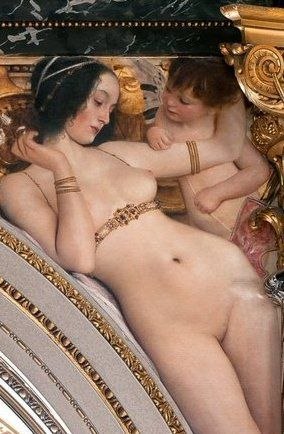
Gustav Klimt (Austrian, 1862–1918) — the man the University of Vienna officially labeled:
• Pornographic
• Erotic
• Indecent
• A threat to traditional values
87 professors signed a protest to stop him.
And they failed. Spectacularly. He quit the commission, kept the money, and painted even more beautiful naked women, now with extra gold leaf.
The year was 1900. Klimt had been commissioned to paint the ceiling of the University of Vienna’s Great Hall — three allegories: Philosophy, Medicine, Jurisprudence. When Philosophy was shown, 87 professors signed a petition denouncing it: the figures were too explicit, too erotic, too ‘pornographic,’ too much reality for an institution that wanted dignified allegories. They wanted Athena with a helmet and a book. Klimt gave them a universe of tangled nude bodies and floating skulls.
Klimt’s response is one of the greatest artistic middle fingers in history: he wrote back that he was done with the commission, returned his advance — wait, no, he KEPT the money, quit the project, and the paintings ended up bought by collectors instead. Then he went on to paint The Kiss, Judith, Danae, and the entire golden period that made him the most famous Austrian painter ever. The professors got a burned-out Great Hall and a footnote. Klimt got immortality.
Also worth noting: the three Faculty Paintings were destroyed in 1945 during the final days of WWII when the retreating SS set fire to Schloss Immendorf castle, where they were stored. So the paintings the professors hated so much no longer exist — we only have photographs. The protest worked after all, just took 45 years and a war crime.
Moral of the story: 87 professors can sign anything, but they can’t stop a man who’s right about beauty. Also, never pick a fight with an artist over nudity; history will side with the artist, every single time.
RIP the Faculty Paintings. They were too hot for this world.

0 Comments