
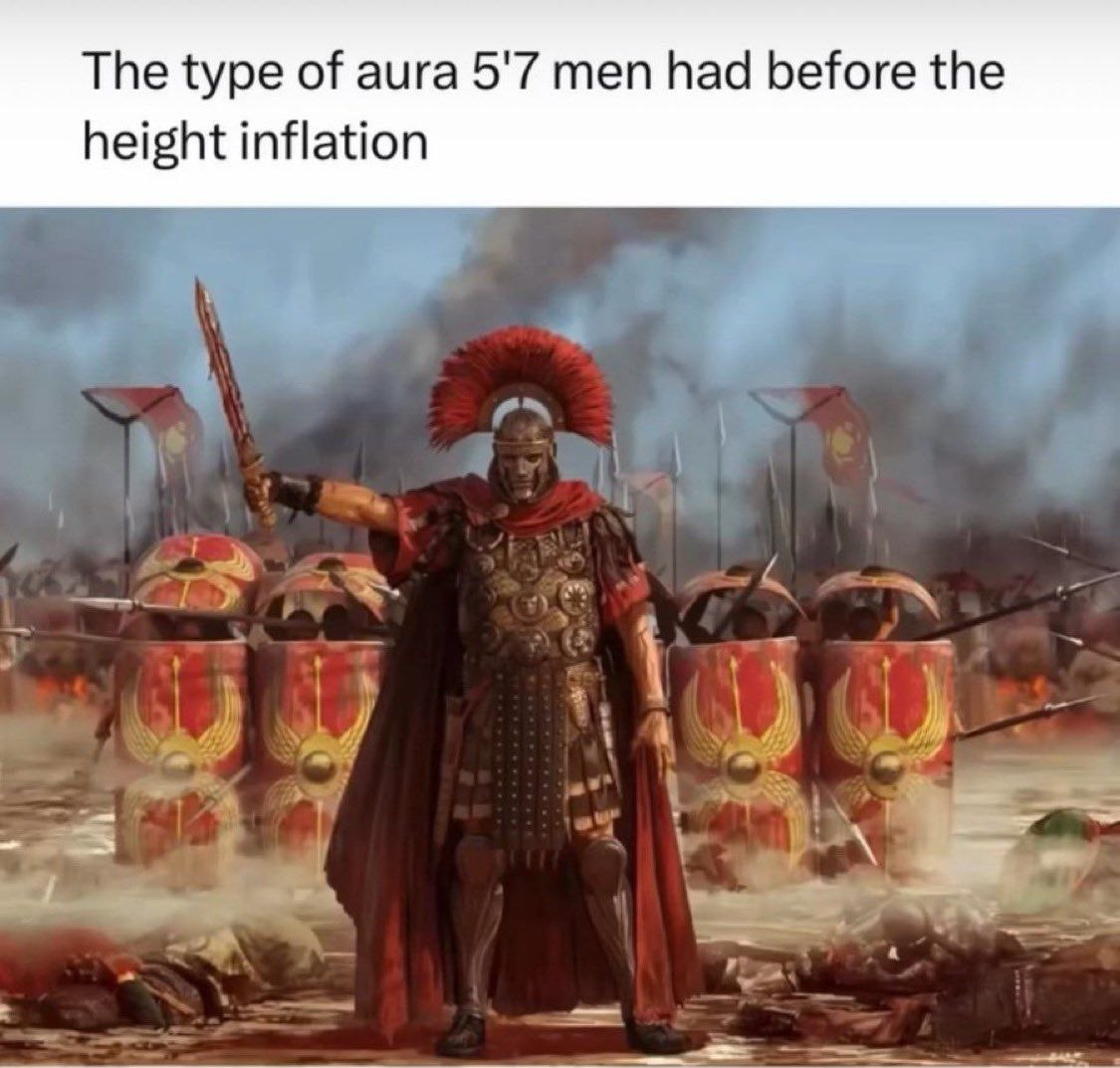
A dramatic painting of a Roman general leading his army into battle — sword raised, red plume flowing, smoke and fire in the background. The caption: "The type of aura 5’7 men had before the height inflation."
The joke: In ancient Rome, the average height was around 5’4" to 5’5" (163-165 cm). A man who was 5’7" (170 cm) would have been genuinely tall for his time — commanding presence, physically imposing, leader-of-men material. The painting shows exactly that kind of figure: a general whose troops look up to him literally and figuratively.
Fast forward to today, and 5’7" is considered short. Height inflation — driven by improved nutrition, healthcare, and changing demographics — has shifted the baseline so dramatically that what was once a tall Roman general would now be average at best. The meme captures the "aura" gap: the same height that once commanded legions now gets filtered out of dating apps.
🎙️ Gorgocutie Explains: Height Inflation Through the Ages
👋 Alex: So this is basically saying short guys had it better in ancient Rome?
💋 Gorgocutie: They weren’t short for their time, Alex. That’s the whole point. A 5’7" Roman was TALL. The average Roman male was around 5’4" or 5’5". Skeletal evidence from Herculaneum and Pompeii confirms it. A 5’7" centurion would have genuinely towered over his men.
👋 Alex: So what changed?
💋 Gorgocutie: Nutrition, mostly. The average height has risen dramatically since the Industrial Revolution — better food, fewer childhood diseases, more protein. The Dutch went from being one of the shortest populations in Europe to the tallest in the world in just 150 years. What was a commanding height in 100 AD is barely average at a 7-Eleven in 2026.
👋 The painting itself? It’s a scene from one of the Roman Republic’s many wars — probably showing a consul or legate leading from the front, which was absolutely a thing they did. Roman generals fought alongside their men, which is why being physically imposing actually mattered for leadership.

0 Comments