
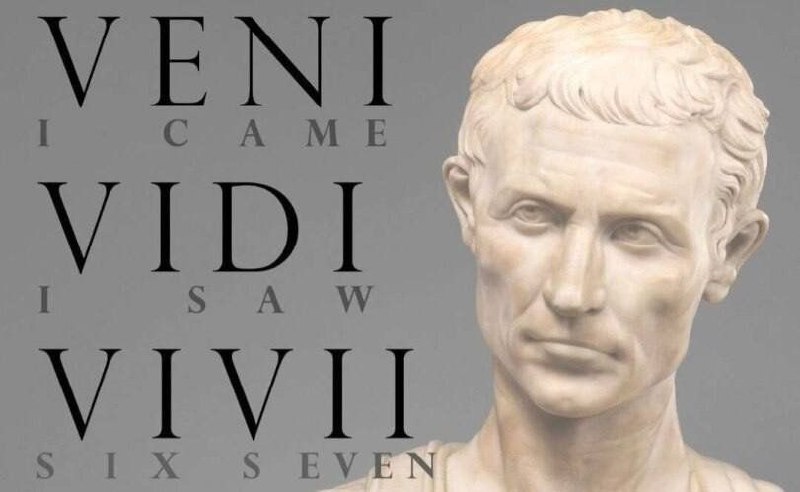
VENI — I came.
VIDI — I saw.
VIVI — Six seven.
Every Latin student knows the real phrase: Veni, vidi, vici — I came, I saw, I conquered — Julius Caesar’s famous 47 BC report back to Rome after the Battle of Zela, the shortest and most flex-worthy military dispatch in history. Three words. Total victory. No further elaboration needed.
This version, however, is the meme edition: Veni, vidi, vivi — “six seven.” The joke is a phonetic pun that only works if you say it out loud: ‘Vici’ (wee-kee) becomes ‘Vivi’ (wee-vee) which sounds like ’66’ — six six — and the internet, being the internet, decided the correct translation of the punchline is ‘six seven’ because one of them isn’t even trying to be accurate anymore.
The beauty of the meme is how it treats the most famous Latin quote of all time like a pop song lyric being butchered in a karaoke bar. I came. I saw. I… six seven. It’s the linguistic equivalent of a PowerPoint presentation where the last slide has a typo and everyone is too impressed by the first two slides to care.
There’s something deeply human about the degradation. Caesar conquered Gaul, Britain, Egypt, and the Senate’s patience, and 2,000 years later his immortal words are being rendered as a number joke on a meme about a marble bust. The fall of empires is one thing; the fall of your own catchphrase into a math pun is another.
Still, the structure holds. Veni, vidi, vici is untouchable as a piece of rhetoric — three parallel verbs, each one shorter and more final than the last, a perfect crescendo of action. Even in its ‘six seven’ form, you can feel the rhythm. I came. I saw. I did the math and it was six seven.
Et tu, meme?

0 Comments