
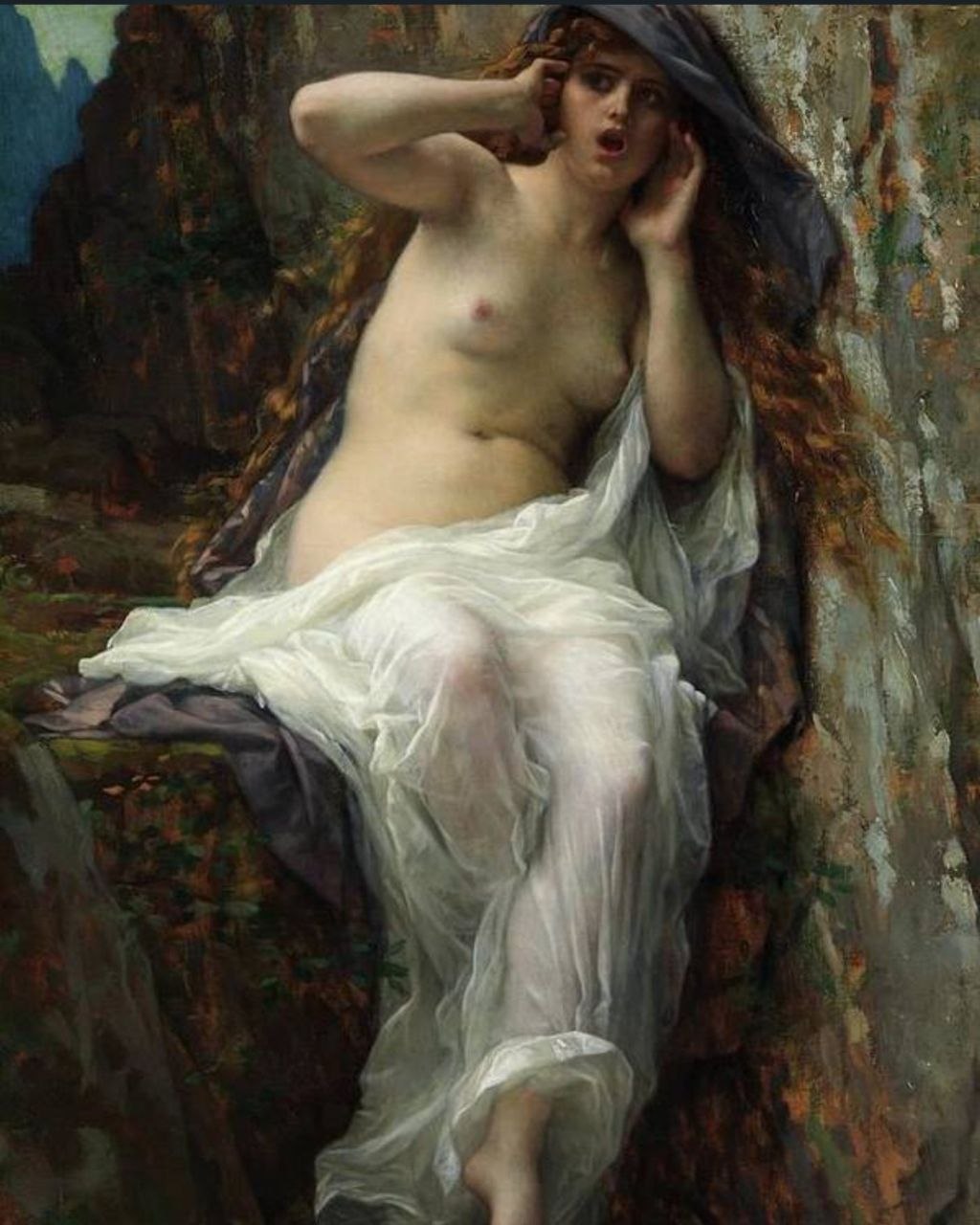
Alexandre Cabanel (French, 1823–1889) — Echo, 1874. Oil on canvas, Metropolitan Museum of Art.
The nymph who couldn’t say anything original, painted by the most successful academic painter of his generation — who also painted nothing original, and got extremely rich off it. The circle completes itself.
Echo, the girl who talks too much, runs into the god who hates talkers, gets cursed by Hera to only repeat the last words she hears, falls in love with Narcissus, gets rejected, wastes away until only her voice remains. The original ‘last seen: forever ago.’ Cabanel paints her as a gorgeous young woman draped in fabric, because of course he does — Cabanel’s whole brand was gorgeous women in states of undress, and he built the single most successful art career in 19th century France on exactly that.
This Echo is not the withered ghost of the myth. This is Echo before the curse really lands — beautiful, intact, looking like she’s about to say something. Which she will, and it won’t be hers.
Cabanel was the man the Impressionists were raging against: they wanted light and movement and the modern world, he gave the Salon what it wanted — polished, mythologized, smooth-skinned perfection — and was paid accordingly. His Venus (Birth of Venus, 1863) was the most famous painting in France for a decade. The Met bought this Echo in 1894, five years after his death, and it’s been politely judging tourists ever since.
The irony of painting a nymph who can only repeat others: Cabanel himself spent his whole career repeating the formula that worked — mythology, nudity, flawless finish — and the formula worked so well that the Impressionists had to invent an entire new movement just to escape him. Echo repeats. Cabanel repeats. The Salon repeats. Everyone’s just saying the same words over and over, and Hera is somewhere laughing.

0 Comments