
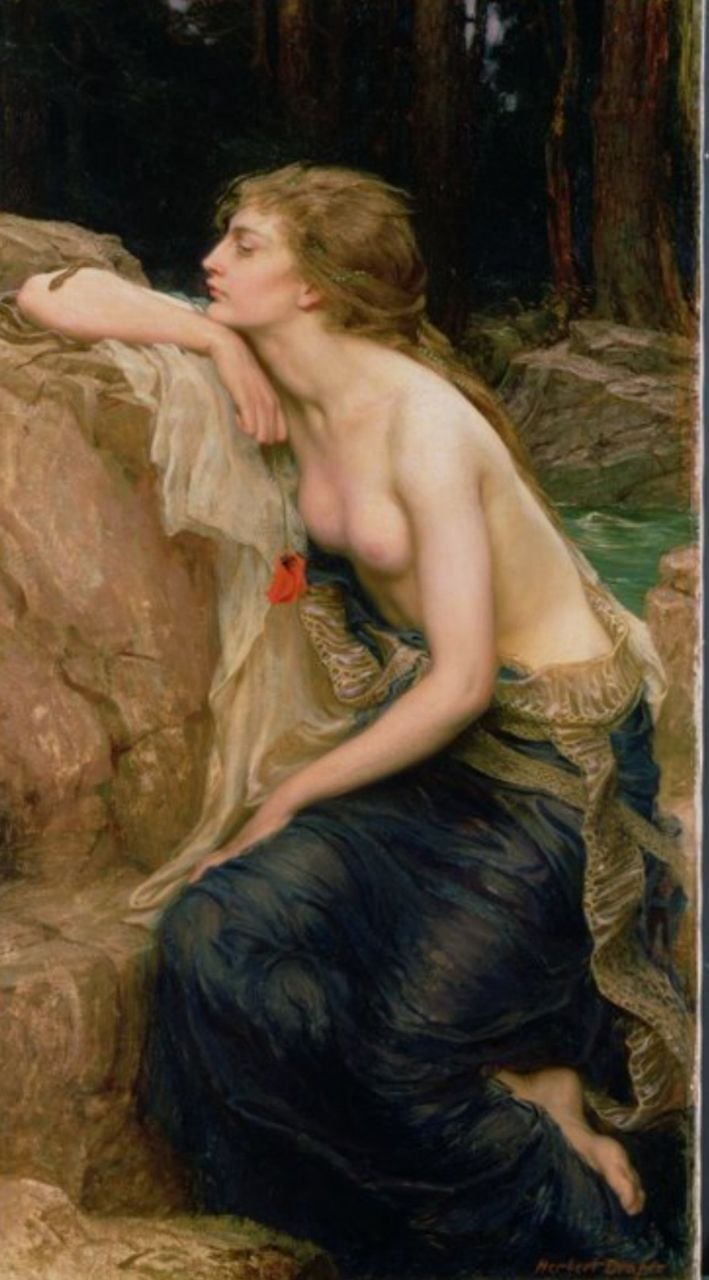
Herbert James Draper (British, 1863–1920) — Lamia, 1909. Oil on canvas.
Lamia, everyone. The mythological child-eating monster. And Draper painted her as a sad, pretty girl by a stream with one red poppy, because Victorian painters looked at a woman who devoured children and said “but what if she was just misunderstood though.”
Lore check: Lamia was a Libyan queen beloved by Zeus, then Hera cursed her — either took her children or made her eat them depending on the version — and she became a daemon that hunts and devours the children of others. By the Renaissance she’d been downgraded to a sort of snake-woman seductress, and by the 19th century she was just “dangerous babe,” full stop. Keats wrote a whole poem where she’s a snake in disguise who seduces a guy and everything ends badly, and the Victorians loved her so much they basically made her the femboy of classical mythology.
Draper’s Lamia is peak Victorian horny-with-plausible-deniability: she’s draped in a sheer garment that has coverage in the way a fishnet has coverage, seated on a rock with the classic thousand-yard stare, and the only clue that this is a monster is the poppy — flower of sleep and death — pinned at her hip. Subtle. Very subtle, Herbert.
He spent his career doing this: Ulysses and the Sirens, The Lament for Icarus, water nymphs everywhere. The man painted so many mythological women that he basically had a staff of models on retainer, and his real subject was always the same — beautiful women in states of undress having feelings. Lamia here is pensive, melancholic, maybe a little hungry. Don’t ask what she’s hungry for. Actually, the poppy answers that.
Also the background is doing serious work: dark forest, murky water, nowhere to run. She’s the predator in a horror movie that’s filmed like a perfume ad.
Fun fact: Draper died in 1920 after an illness, and his studio sale was a sad affair — but Lamia survived as one of the definitive images of Victorian mythological painting. The monster got the last laugh.

0 Comments