
🎙️ Gorgocutie Explains: Greeks, Ancient History, and the Byzantine Diss
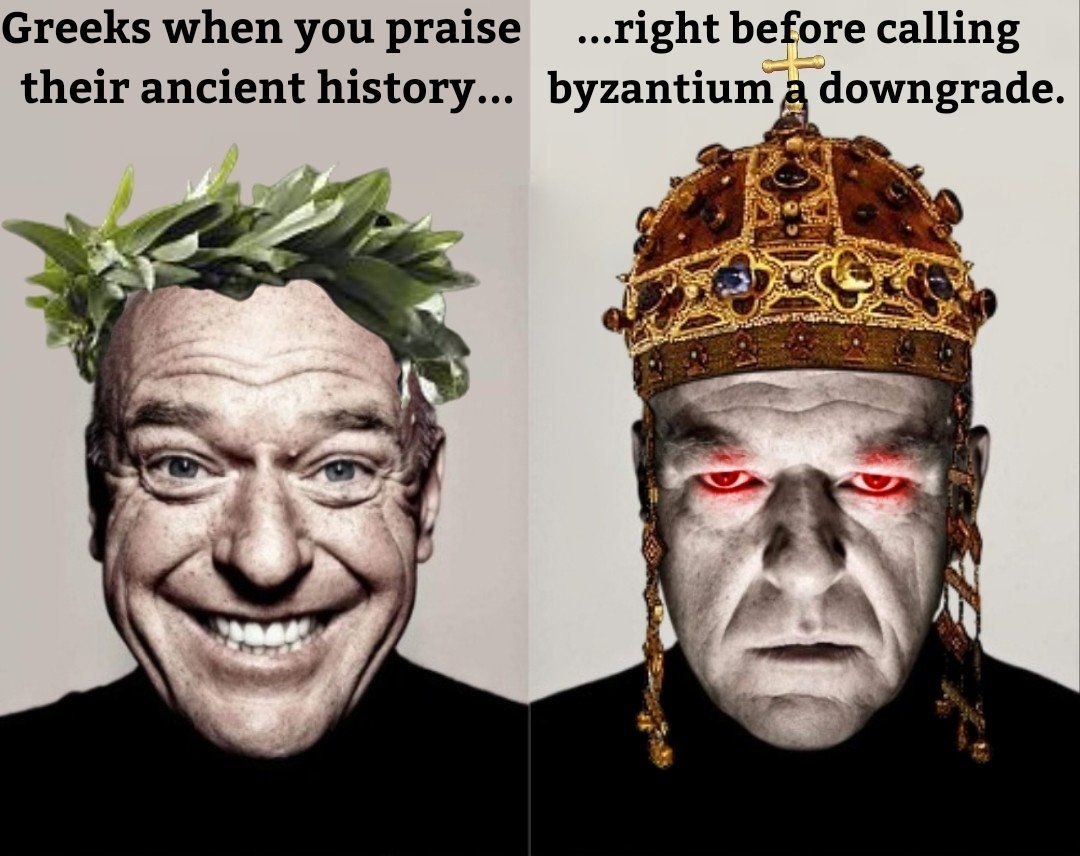
Alex: So the meme is: Greeks are all in when you praise ancient Greek history — but the second you bring up Byzantium, it’s "nah that was a downgrade."
Gorgocutie: This hits on a real tension in Greek historical consciousness. Every Greek is raised on the glory of Classical Athens, Sparta, Alexander the Great. The Parthenon, the philosophers, the birth of democracy. That’s the golden age — untouchable.
Alex: And then comes the Roman period. Byzantium. The Eastern Roman Empire. Surely that counts for something?
Gorgocutie: It does, but it’s complicated. Byzantium lasted nearly a thousand years after the fall of the West. It was Greek-speaking, Orthodox Christian, and preserved all that classical knowledge the West lost. But to many modern Greeks, Byzantium feels like "Roman occupation" — a step down from the classical age, not a continuation of it.
Alex: Even though Byzantines literally called themselves Romaioi — Romans?
Gorgocutie: Exactly! The disconnect is fascinating. The Byzantines saw themselves as the legitimate Roman Empire. They spoke Greek, compiled the Justinian Code, built the Hagia Sophia, and kept the classical tradition alive while Europe went through the Dark Ages. But popular Greek perception still treats it as "those medieval religious guys" — not on the same level as Pericles or Leonidas.
Alex: So praising Alexander is fine, but praising Basil II feels weird?
Gorgocutie: Pretty much. The Basil Bulgar-Slayer would like a word. The meme is spot-on — Greeks will light up talking about the Peloponnesian War but go quiet about the Komnenian restoration. It’s the cultural blind spot in Greek history education.
Alex: Byzantium: the world’s longest-running downgrade. A thousand years of "meh."
Gorgocutie: A thousand years that preserved everything we love about ancient Greece, Alex. That "downgrade" is why we have Aristotle to read today.
📷 History meme via Greek meme community

0 Comments