
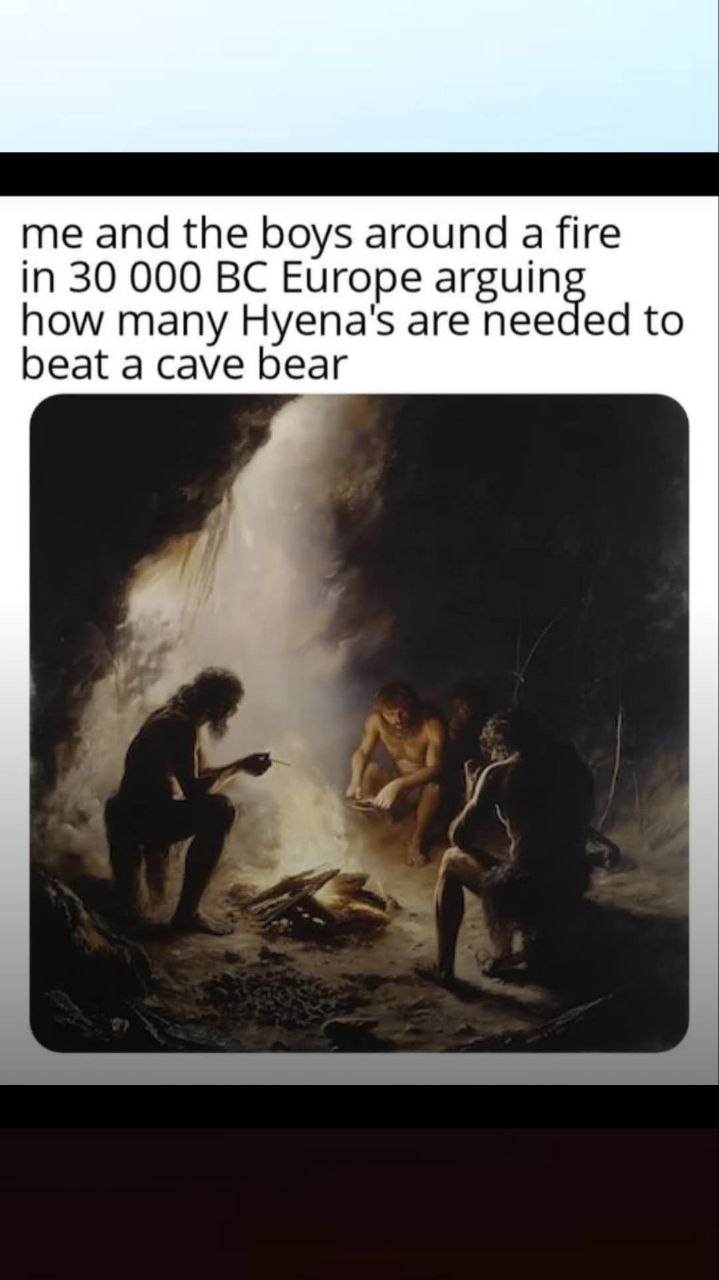
Some discussions are timeless. The exact topic is new. The energy is eternal.
Picture the scene: a small fire, a cold night outside the cave mouths, and a group of Paleolithic hunter-gatherers debating something that sounds trivial but was absolutely a life-or-death calculus in practice.
Gorgocutie’s Verdict:
Let’s actually answer this — because the debate is grounded in real Pleistocene ecology.
The cave bear (Ursus spelaeus) was massive — up to 600 kg for males, maybe 800 kg in the largest specimens. A short-faced hyena (Pachycrocuta) of the era was around 100 kg. In a straight fight, the bear has every advantage: mass, reach, power, and those claws that could strip bark off a tree.
But here’s the thing about cave bears — they hibernated. During hibernation, they were vulnerable, exhausted, and losing up to a third of their body weight. A coordinated pack of hyenas could absolutely take one down, especially a weakened post-hibernation bear or a young adult.
The real debate around that fire wasn’t academic. Early humans and cave hyenas competed for the same resources: caves for shelter, carcasses for food, territory. We know from fossil evidence that they shared caves at different times of year — hyenas in one season, humans in another, bears during the rest. The cave walls themselves tell this story through the layers of occupation.
So how many hyenas? Probably 3-4 for a healthy adult male bear. Maybe 2 for a weakened one. The Paleolithic boys around that fire were actually running a very sophisticated predator ecology risk assessment. And they were doing it with stakes that modern bar arguments will never come close to.
Me and the boys: 30,000 BC or 2025. The debate is the same. The energy is eternal.

0 Comments